How to Choose the Best Business Electricity Supplier for Your Needs
Posted on January 24, 2024 by Keith Jones

Selecting the appropriate business electricity supplier can be a challenging task. The market is filled with a wide array of options, requiring businesses to thoughtfully consider a range of factors before settling on a decision. Leveraging a business energy comparison site such as Business Energy UK can substantially alleviate a company's financial pressures, diminish its environmental impact, and boost its overall productivity.
Read More!
Posted in CommunityEnergy, electric vehicles, Wales | Tagged community energy, efficiency, energy, energy efficiency, energy use, IWA, Keith Jones, sustainability, Wales |
Spoilt fror choice or not knowing which horse to back… energy conundrum?
Posted on February 12, 2018 by Keith Jones

My PV this February. Not producing electricity on a sunny day when I needed it the most in a cold house. There are some weaknesses in renewable energy systems and we need to build more capacity than we use at peak to get over these weaknesses. see further on!
Tomorrow I will be a panelist in the Institute of Welsh Affairs event in Bangor University debating ‘Whats the best future energy mix of energy for North Wales and its people’ I’m there representing distributed and community energy. For me the case of localised energy is a simple one of local decision-making, accountability and benefit retention. For example in terms of the £20 billion going into the new nuclear power plant on Anglesey the control is really with the foreign banks and or Westminster in what they will offer to said banks. For many of the community energy schemes I have been involved in the decision is local first and then government bodies second in terms of consents and support. The Welsh Government have set their stall out in terms of declaring that every new energy scheme must have an element of local ownership (not sure a £20 billion nuclear power station counts… oh yes forgot as this is outside WG powers and decisions is from Westminster. back to accountability, decision-making and who does it?) but they have set a very laudable ambition of 1 GW of generation will be in local ownership (lots of definitions need clarifying here but they are consulting on ‘local’)
The model we have wont work if we want a 100% renewable energy as we have a very centralised grid system and a decentralised environmental resource (can be windy or not, night-time and so on, wind on far side of the country… we’d be fine if we could move the cities to the resource but. ha)
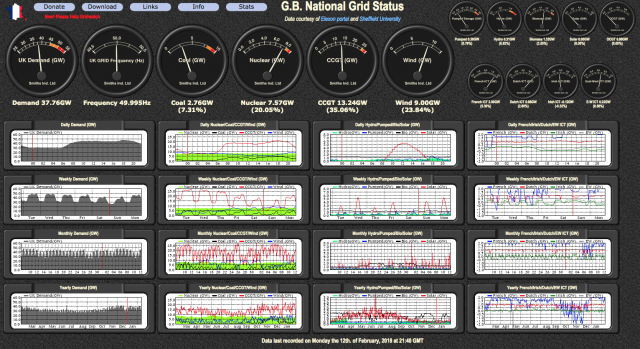
We have a mixed grid but also not much spare capacity in the UK. The interconnections can also be flat-out for much of this time of year and all its takes if for one of the main power stations to trip over and the frequency goes and system failure can cascade off and then we get into black starts (Have a look at Wikipedia). ‘we’re all doomed Mr Mannering!’
I saw an excellent presentation by John Gowdy of Regen on what would be needed to meet our current UK electricity need of about 50GW ish load from renewable sources and simply put we need about 80GW of renewable energy generation capacity because of the load factor of renewables. The question I always ask is do we have enough power on a cloudy, dry, still February (day or month) when demand is at peak but renewable energy is not? (This 50GW is currently free from Electrical Vehicles, more computing server capacity, possible air conditioning growth based on climate change, more houses…) I am a 100% believer in renewable energy but we need to look at the way we pay for, distribute and store energy if we want to reach this future (and will we pay for it?) simple question. If we put the estimated combined £50 billion budget of Hinkley and Wylfa Newydd into energy efficiency in order that we use much less electricity than the Nuclear could generate (don’t know) I wonder what the economics would be? But we live with a market economy where we pay for products and not for the energy we don’t use. (I won’t go into demand side management for now) Current energy storage will be fine for a few hours but not for a few days. We use storage as a sort of top up at the moment and not as a big gap filler (we don’t have a enough storage and by quite a margin) then we get into interconnections with other countries and the whole thing gets even more complicated (won’t mention Brexit)
It’s going to be an interesting debate tomorrow. We don’t have a choice in terms of a low carbon future but the ‘how’ is up in the air at the moment. Back to my title question in terms of ‘which horse to back?’ If we have the money…all of them, then we will be guaranteed to win. but also we need to look at a business model which values the energy we don’t use in order to get some serious investment in there.
Posted in CommunityEnergy, electric vehicles, Wales | Tagged community energy, efficiency, energy, energy efficiency, energy use, IWA, Keith Jones, sustainability, Wales |
The National Trust’s research ambitions. Knowing more, to look after what we all care for better
Posted on February 6, 2018 by Keith Jones
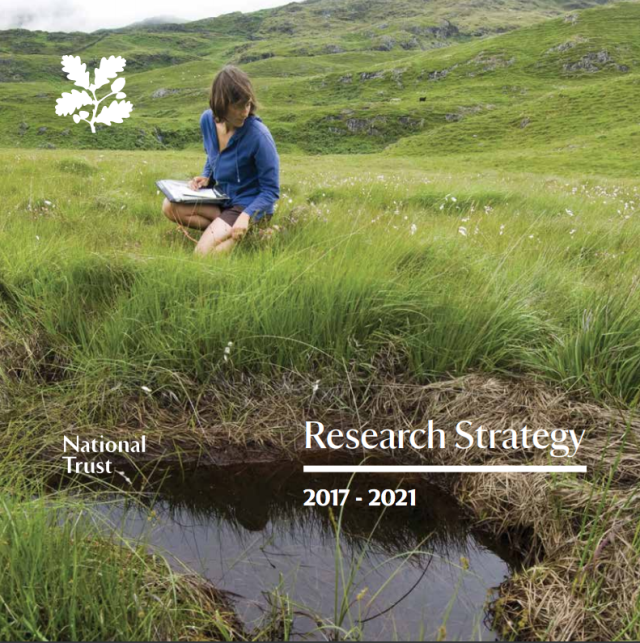
The National Trust research strategy. Sabine on the front cover who has been quietly researching and monitoring the impact of our land management practices at Hafod y Llan for over a decade now
Yesterday and it was Manchester. I attended one of the three workshops the National Trust is holding on its journey to setting itself up as an accredited Independent Research Organisation but also developing on its new research strategy into a research and delivery plan. The NT is famed for its research but usually this is based on various criteria such as local need, national programme, personal interest or often as a host for others as we hold a huge array of resources from land to people to built structures, libraries, archaeology but also as a willing partner to help others to help ourselves. The NT is joining all of this together through its staregy
The workshop was good in getting me to think of the wider meaning of research and not just peer-reviewed papers in an esteemed journal but for me everything from evaluating turbines for durability through to the sustainability of paints right down to the whole life analysis of a disposable coffee cup! Research at its root is simply ‘finding’ things out
The word research is derived from the Middle French “recherche“, which means “to go about seeking”, the term itself being derived from the Old French term “recerchier” a compound word from “re-” + “cerchier”, or “sercher”, meaning ‘search’.
In my world I have quite a few ‘research projects of the go and these include
- Developing on using Water Pumps as hydro turbines with Trinity College Dublin
- (PhD) Climate change modeling on National Trust sites in Wales with Bangor University
- (PhD) Community energy contributions the Wales Future Generations Act (Bangor University )
- (PhD) Heat harvesting for re-use from waste water at a National Trust property
- Monitoring and performance approaches to NT renewable energy systems
…and the list goes on! But overall its to add value, establish clarity or look at new approaches to the day job. It will be interesting to see how we the Nation Trust focuses its lens on the huge range of research possibilities based on the vast amount of work we have to do day-to-day looking after things, explaining, engaging, making things relevant, learning from the past to help the future and all that

For example every time we build a hydro we have to do a huge amount of research to make sure the system is appropriate for the site. This is the Hafod y Porth hydro near Snowdon. We found that the system is actually on the site of the old hydro (archaeological research). This is was one of the first totally prefabricated weir systems installed (technical research). Research, research, research!
Posted in Hydro, Wales | Tagged climate, community, Hafod y Porth Hydro, hydro, Independent Research Organisation, Keith Jones, National Trust Blog, National Trust Research Strategy, National Trust Wales, sustainability, Wales |
Kerb stones, mud, manure = fantastic pizza!
Posted on February 3, 2018 by Keith Jones
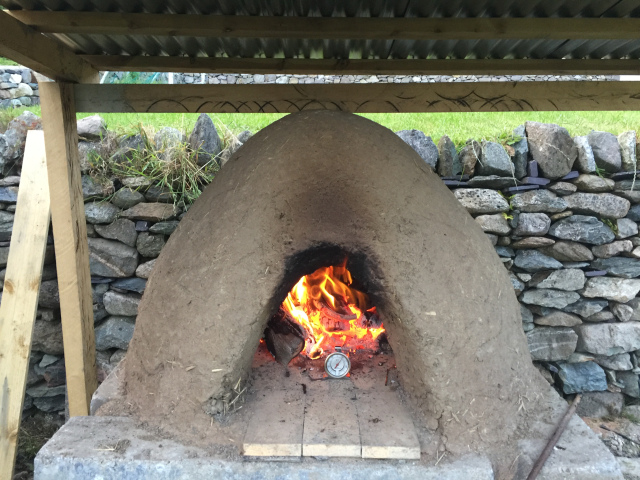
The clay earth oven is now complete and making fantastic pizza
Forgot to do this blog this summer. I set myself a goal to build and earth oven in the back garden. I have been thinking about it for a while and when they found the remains of the oldest in the UK under where we were going to build the National Trust Penrhyn Castle biomass system it sort of sealed it.
The base is made of free recycled concrete kerb stones thanks to Gwynedd Council (they were re doing a cycle path near the house and I asked if I could have them). the void in the base is filled with broken kerb and broken bricks topped off with 6″ of sand. A base of thermal bricks I found and then the oven was built over 10 days in three layers of mud, gravel, sand, straw and two types of manure!
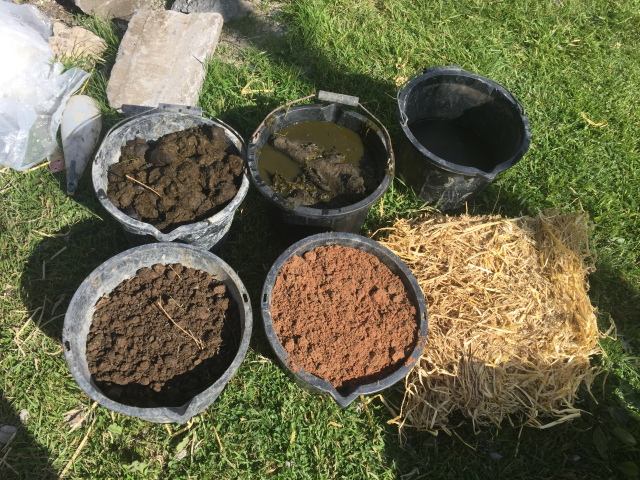
The raw ingredients of an earth oven. Cow manure has a binding enzyme in it and horse manure has small grasses in it for the final coat.I’m also blessed in having horrible soil for gardening but fantastic of earth oven. Very, very heavy clay
Thanks to ‘Building with Cob’ book for leading me through the method and the measurements. Getting the door aperture right in relation to the internal void is key. (the door has to be 61% of the height of the inside of the dome) building a ‘former’ out of sand and then covering in wet news paper for the first layer to take with no straw (thermal layer)

sand former with newspaper cover. This paper stops the clay binding with the sand and makes digging the sand out of the dome easier once completed. I should have used second-hand ones from a storage heaters as they are thicker
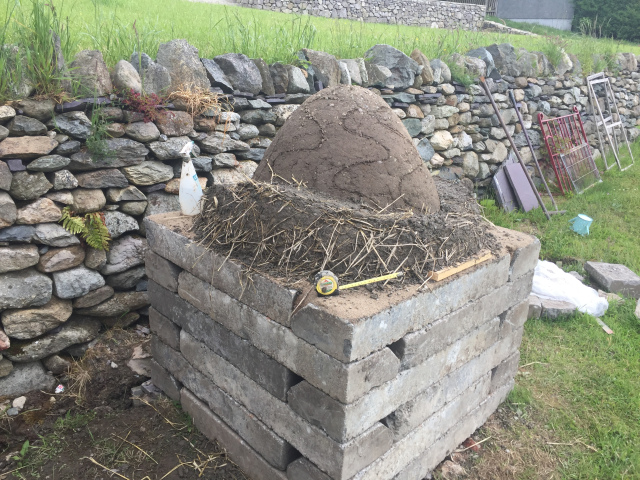
You can see the first thermal layer with a part built second layer ‘insulation’ with the straw in it
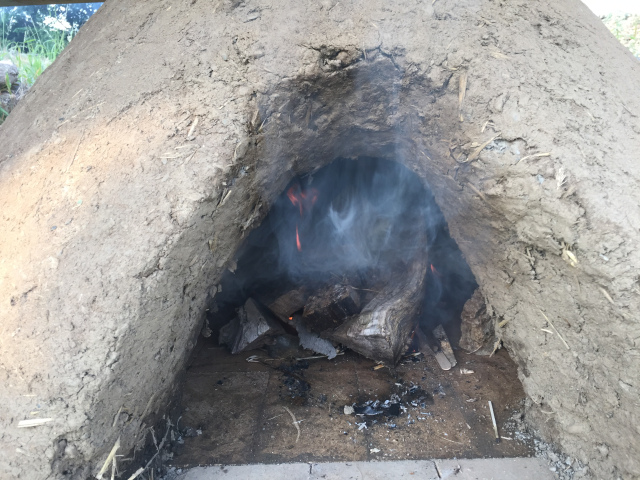
you can see the stratification of exiting smoke and the intake lower layer with fresh air entering nicely in this image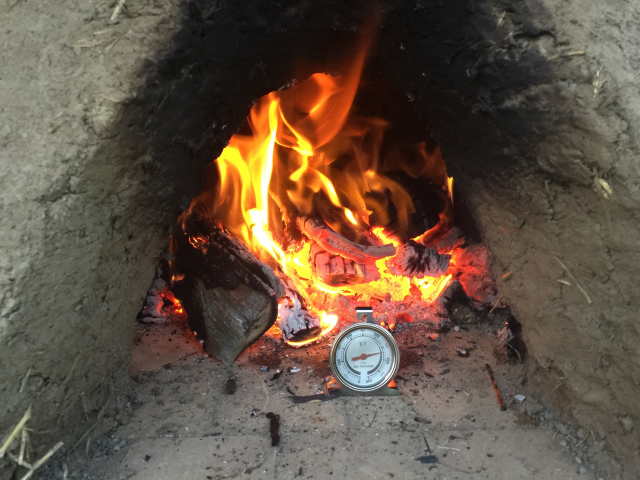
Its was a good few days of work (The earth, sand and straw was mixed with a tarpaulin). The whole thing was more or less free except for the thermometer and some borrowed bits (£3.50 for the thermometer). What I’d do differently next time?More straw in the final finishing layer to stop the surface cracks.
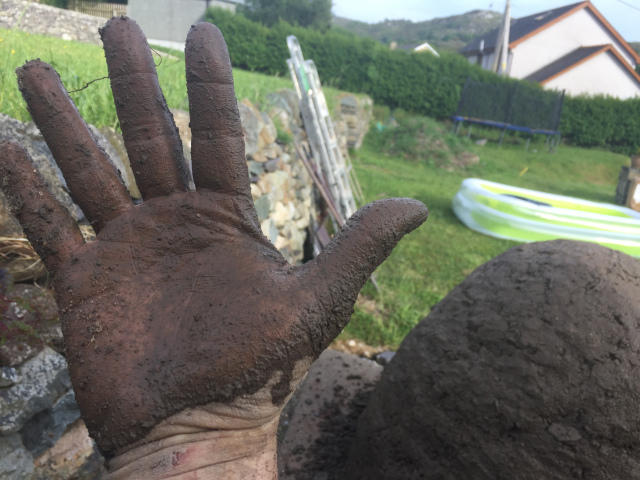
Here is the essential tool for most of the work. (manure as well)
Posted in Biomass, Wales | Tagged clay oven, earth oven, pizza oven |
…and which log stove did i choose?
Posted on February 1, 2018 by Keith Jones

Quick update on the log stove I went for! Both the Morso Owl and the Jones family are happy. 6.25kw seems the perfect heat loss for my old house. I have a vent through my 1.1m thick wall to make the stove and building regs happy
Firstly thanks to all those who suggested makes and types from my previous blog . In the end I went for a Morso Owl. There are several reasons why. The main one being the shape of my square, deep inglenook with the flue right at the back meant that I needed a back flue system and a deep rather than a shallow and wide stove. My heart was initially set on the Burley Fireball as it is the most efficient log stove in the world. But with a top flue only on a tall shallow stove meant that I had no room to put bends in to push the stove out to get the heat in the room rather than warm up the inglenook which would have been lovely by the time I went to bed (Part J building regs had a part to play here as well)
having been an official buyer of many stoves from Ebay for years this time i went for a new stove with a 10 year warranty and parts are really cheap. I now have for the first time something called a rolling flame which indicated my stove is correctly sized and happy. An efficient stove is one which is driven hard, burns cleaner with less residue
I also splashed out on an Ecofan 810. Stove top thermoelectric fan (heat turned into electricity to power the fan. starts working at 65C up to 350C) the fan system gets heat out of the fireplace earlier and into my room. I did some academic research into TEG’s as its abbreviated into and it seems to work. (my limited hair is moved when I put logs in…which to me means warm air is being pushed out more than through heat convection and radiation)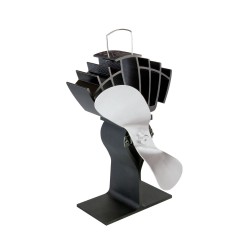
Posted in Biomass, Wales | Tagged Burley Stoves, ecofan, ecofan 810, Keith Jones, log stove, Morso Owl, National Trust Blog, Paul Southall, sustainability, Wales |
That’s a pretty power-house! Re visit to the hydro projects in the Lake District. Quality!
Posted on January 31, 2018 by Keith Jones

Hayeswater Powerhouse. I dare you to tell me this does not fit into its landscape. Stunning site. Thanks to an additional donation the project has also already repaired over 500m of Lakeland wall around the powerhouse and helped safeguard / repaired the scheduled ancient monument below the powerhouse (old lead mine workings with a huge water wheel pit which again Storm Desmond took a chunk out of )
Give credit where credit’s due. The National Trust in Wales are known as ground breakers within the NT for doing environmental work especially renewable energy but the Lake District… and it pains me to say this, do build really tidy hydro power houses! (Wales do good work but the stone work on the Lake District systems is stunning…being an aficionado of good stone work!) I’m not a fan of pastiche but when something is well build and the skill shines through then the stone and roof work on the NT built hydros in the Lakes are a joy to the eye

The innovative twin hydrolite turbines in Hayswater .
Never been done before with Hydrolites. (generated 1.1GWh in the last 12 months) The hydro has not missed a beat and is an example to others

Hause Gill hydro power house near the village. Again this is stunning stonework

The chilli intake over 200m above Hayeswater on the entrance to the old reservoir and next to the reservoir access track. Mr Garry Sharples modeling the latest in weir design
I was up North again today in the snow…the stingy on the face type. To revisit the hydros I saw well over a year ago which were then cutting the turf. Hayeswater and Hause Gill. The former is a 250kw twin hydrolite turbine system and the later a 100kw Gilkes pelton system. I was there early on during site selection and did a little bit of support in the very early days. Both built-in sensitive locations within typical Lake District valleys and by god do they fit into their landscapes. Garry and John should be very proud of these projects. Hayswater was built-in the teeth of storm Desmond which had a good go at destroying the National Park and the hydro was delayed for quite a while as the main contractor was helping dig out the village of Glenridding at the bottom of the valley (the village have re named one of the bars to thank the contractor of the Hayeswater hydro contractor who came through flood and high water from the hydro site to help when the village were most in need. Beckside Bar as its now called) I know the NT have a reputation for high quality but in the Lakes our efforts in site selection and design were and are actively supported by the Friends of the Lakes
Posted in Hydro, North West | Tagged Fit for the future, Hause Gill, Hayswater, hydro, Keith Jones, National Trust, National Trust Blog, Paul Southall, sustainability, Wales, water |
Who Cyd Ynni are as a group. More than the sum of its parts. Come and work with us!
Its been a few years since we created the Cyd Ynni network / consortium in NW Wales. the community energy companies of Ynni Ogwen, Ynni Padarn Peris, Ynni Anafon, Ynni Ocar and Fferm Moelyci decided to share assets, gain more by working together and working on a cooperative future for all of our communities. The National Trust has been helping in back ground through sharing and enabling. As a group following the kick off project which was selecting Bethesda to trial the energy local trial as they were in the best place as a community to take this on. we have also as group been tackling the Business rates debacle on community energy and cross fingers we should be there in the new financial year. We then bid to the EU Leader (Arloisi Gwynedd) fund for support to create our business plan. We got the support and this work was taken on by TGV’s Chris Blake and supported by DEG’s Grant Peisley. In the mean time we also won last years Community Energy England and Wales award for partnership working. This is a long-winded way of saying that the Cyd Ynni concept has been successful in gaining £250k of BIG Lottery funding to enable, support and deliver a whole list of community energy projects (despite the government) in NW Wales. The fund is there to enable and to tackle the big problem in all community projects which is the ‘capacity to deliver at scale conundrum’ as we are all volunteers. This BIG Lottery fund project aims to deal with this through the creation of two new jobs and also be based in the best part of the UK (in the shadow of the Snowdonian mountains). Because of the uncertainties of state aid from this funding and its impact on the community energy companies DEG have kindly agreed to provide the back office and host for the funding. Have a look!
The Jobs can be found here… but hurry!
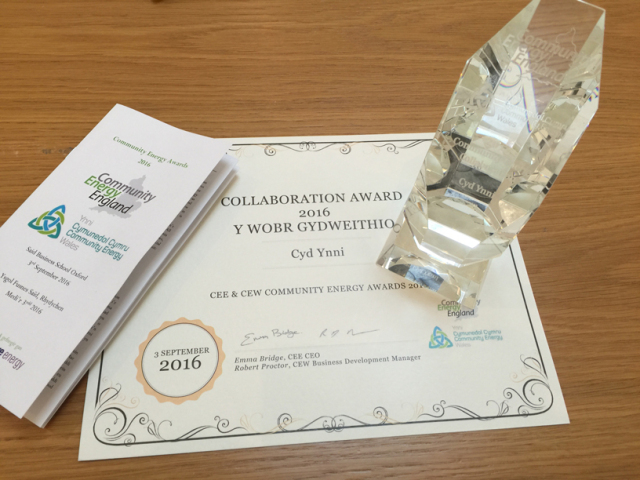
We do good, ground breaking work! and we happen to be nice people who work with more nice people
Posted in CommunityEnergy, Wales | Tagged community energy, cyd ynni |

For example the Hanai Rice terraces have some of the answers to climate adaptation for other areas in the world. Heritage has a ‘today ‘use. Its not just pretty to look at.‘Beautiful and useful’ William Morris
I have had a few weeks since coming back from COP23 in Bonn and thinking about the whole conference but also why I was there. I was there to represent the International National Trust Organisation (INTO) and the National Trust in Wales. Both of which are primarily heritage and conservation organisations and we know that the ever-increasing speed and impact of the changing climate is posing one of the biggest challenges to heritage and the things we hold dear. Culture once its lost is lost for ever. Its is the glue which holds us together, knowing where we came from, hopefully not repeating past mistakes but also giving the world meaning through language and understanding. Landscapes, biodiversity, built and natural, language and tradition are part of the world we live in as much as iPhones, cloud data and EV’s
What we forget in the developed word is that heritage is often seen as ‘other’ and not part of our day-to-day. In the developing world, heritage and the living culture is part of the everyday. Their vanua as the Fijians call it. The countries which can afford least are being impacted the most by climate change. As I have said quite a few times ‘these developing’ countries are picking up our bill for our impact on the world in general by being impacted the most.
What of the conference and heritage? It’s was not really an aspect in COP23 but should have been more and thank heavens for the small band of people flying the flag or the whole thing would not even be considered. Though thanks to INTO and ICOMOS in Paris COP21 and that loss and damage of heritage and culture will be accounted for by the IPCC 6th assessment but ‘how’ and ‘what’ will be an interesting bun fight. The people aspect of the conference and their implicit value is boiled down to money, trade offs and deal making. But I suppose we can not scream against the human world for being self-serving.
For me it was a little sad in terms of what the ‘suits’ were talking about in the main negotiations but the other 17,000 of us sharing and learning was inspirational. The Pacific Climate Warriors fighting for their culture to be valued, the Sami people shouting about impact, the indigenous people’s area was packed. The as I have now called them ‘stopped me in my tracks moment’ was a relatively simple presentation from the Globally Important Agricultural Heritage Systems (GIAHS) the presentation was showing how this modern fast digital world has a lot to learn and share from what has been. We have some of the solutions to dealing with a hotter more stormy, dryer, wetter world and some of it was developed millenia ago. Look back a bit to know where we have come from… it will make the forward journey just a little more tolerable

The Peat restoration work on the Migneint by the National Trust is both mitigating and adapting to climate change. This is a cultural landscape
My highlights and in no order of priority
- GIHAS. see above
- the focus on peat as both a mitigator and an adapter for climate change especially the facts and figs in the conference. We need to take more account of this
- The Pacific Climate Warriors showing that they were fighting and not drowning
- The future of travel and transport (seeing it for real in a big city)
- The people’s delegation from the USA
- Heritage needs a stronger voice in this climate and politically stressed changing world
- its really really important to share!
What will I do differently? Re doubling my mitigation and adaptation work. The answers, technologies are already here and now. We used to be waiting for technology to catch us up. Well it has. Its now a matter of doing but also learning much more from the past
Posted in climate change | Tagged bonn, climate change, climate change adaptation, cop23, energy, environment, Fit for the future, ICOMOS, INTO, Keith Jones, National Trust, National Trust Blog, Paul Southall, sustainability, Wales |